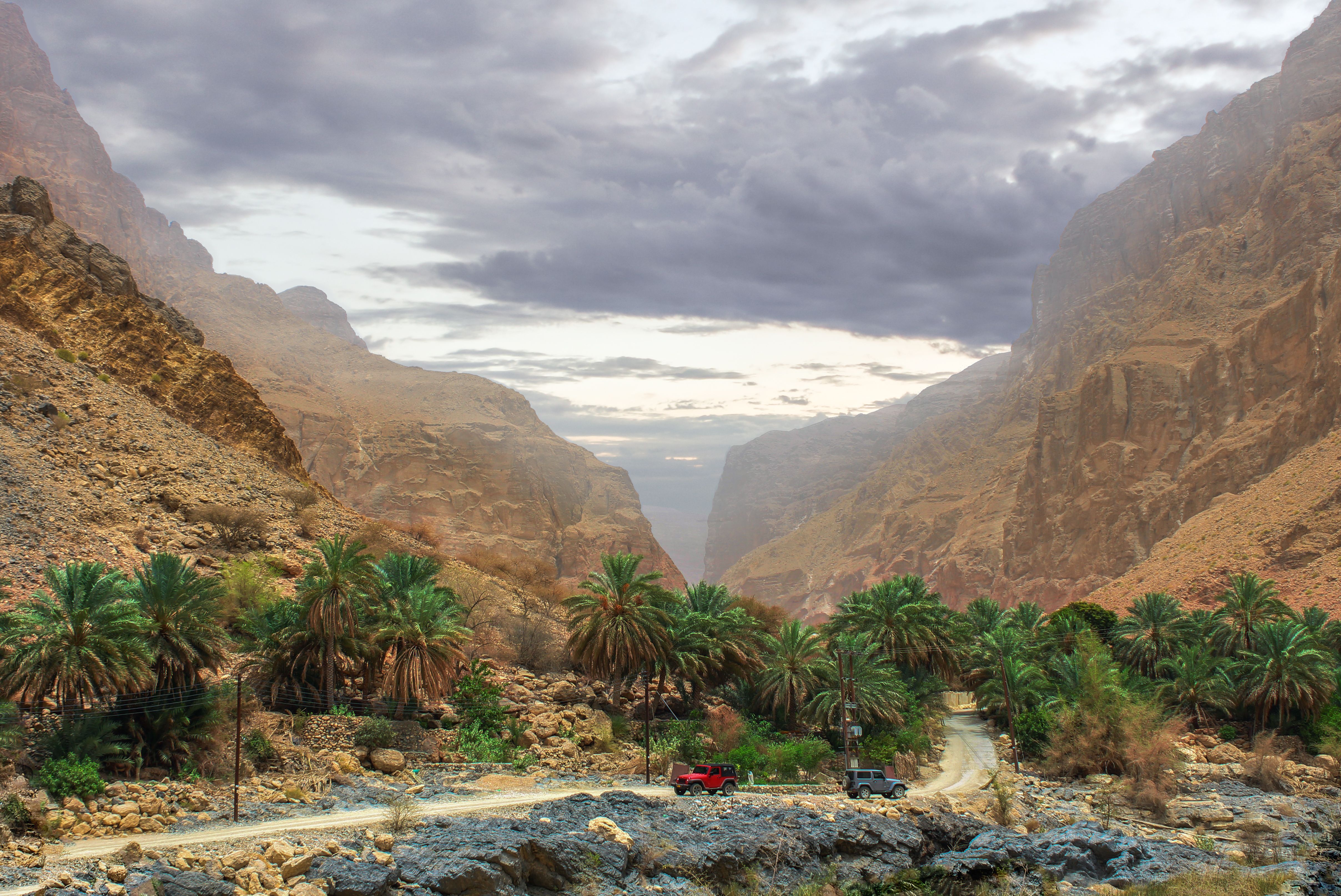
Oman is one of those countries where the road is part of the trip.
You can leave Muscat in the morning, pass through rocky mountains, stop in an old village, swim in a wadi and end the day watching sunset over the desert.
That freedom is one of the biggest reasons a road trip works so well here.
But there are a few things worth understanding before you rent a car and start driving.
Not every road needs a 4WD. Not every desert road should be attempted alone. And a route that looks easy on a map can still turn into a very long day.
Here is what I would want a first-time visitor to know.
Is Oman good for a road trip?
Yes.
For travelers who enjoy driving, Oman is one of the easiest ways to experience the country beyond Muscat.
Many of the places people come to see are spread across northern Oman:
- Muscat
- Nizwa
- Jebel Akhdar
- Jebel Shams
- Sharqiya Sands
- Sur
- Wadi Shab
- Wadi Bani Khalid
- coastal villages and beaches
Having your own vehicle gives you much more flexibility than trying to organize transportation between every stop.
It also lets you stop when something catches your attention, which happens often here.
Are the roads in Oman good?
Most major highways and roads between cities are very good.
The main routes around Muscat, Nizwa, Sur and other larger towns are paved and relatively straightforward.
Road conditions change when you begin exploring:
- mountains
- wadis
- desert areas
- small villages
- remote coastal roads
That does not necessarily mean they are difficult.
It just means you should understand your exact route before assuming your rental car can handle it.
Is driving in Oman difficult?
For most confident drivers, not particularly.
Outside busy parts of Muscat, traffic can be quite light.
Road signs are generally clear, and major routes are easy to follow with navigation.
The bigger challenge is usually distance.
A day that includes three hours of driving, sightseeing, lunch and another long transfer can feel much more tiring than it looked while planning.
I would be more careful about overloading your itinerary than worrying about normal highway driving.
Which side of the road do you drive on in Oman?
Oman drives on the right-hand side of the road.
Vehicles are left-hand drive.
If you normally drive on the right, this will feel familiar.
If you come from a country that drives on the left, give yourself a little extra time when you first collect the car.
Do you need an international driving permit?
Requirements can depend on your license and rental company.
Before traveling, confirm exactly what your rental company requires for your nationality and driving license.
Do not assume that because someone online used their home license, the same rules automatically apply to you.
It is much easier to confirm before arriving than argue about paperwork at the rental desk.
Do you need a 4WD in Oman?
Not for the entire trip.
This is probably the most common misconception about driving in Oman.
A normal sedan is suitable for many popular routes, including much of:
- Muscat
- Nizwa
- Sur
- the main eastern coast highway
- major towns
- many forts and cultural sites
A 4WD becomes important for specific destinations and road conditions.
Do you need a 4WD for Jebel Akhdar?
Yes.
Jebel Akhdar has a checkpoint before the mountain ascent, and an appropriate 4WD is required for access.
The road itself is paved.
The requirement exists because the climb and descent are steep, and the vehicle needs to be suitable for mountain driving.
If Jebel Akhdar is only one day of your itinerary, renting a 4WD for your entire trip may not make sense.
You could use a normal rental car for the rest of the journey and book a guided mountain day such as Nizwa & Jebel Akhdar.
Do you need a 4WD for Jebel Shams?
The route to Jebel Shams is different.
Large parts are paved, but road conditions can vary depending on the route and recent maintenance.
There may be unpaved sections as you travel higher into the mountain area.
Some travelers make the journey in normal cars, while others prefer a 4WD for comfort and confidence.
I would check current road conditions and your rental agreement before deciding.
If you would rather not think about the vehicle or mountain road, Jebel Shams and Misfat Al Abriyeen combines the mountain with one of the area's most interesting villages.
Do you need a 4WD for Sharqiya Sands?
If you are actually driving into the dunes, yes.
But having a 4WD does not automatically mean you know how to drive on sand.
Desert driving is its own skill.
You need to understand things such as:
- tire pressure
- momentum
- which dunes are safe to cross
- what to do if you get stuck
- where you are going
If you have never driven in deep sand, Sharqiya Sands is not where I would recommend experimenting alone.
Many camps can arrange a meeting point or transfer into the desert.
You can also visit as part of A Night in the Sharqiya Sands, which removes the uncertainty around desert access.
Should you rent a 4WD for the whole trip?
Usually not unless your route genuinely requires it.
A 4WD costs more to rent and uses more fuel.
If most of your itinerary is on normal roads, you may be paying extra for a vehicle you only really need once or twice.
Look at your route first.
Then decide which vehicle makes sense.
What is driving in Muscat like?
Muscat is where you are likely to encounter the most traffic.
The city is spread out, and major roads can be busy during commuting periods.
The roads themselves are good, but you need to pay attention to:
- lane changes
- roundabouts
- exits
- speed limits
- other drivers merging
Navigation helps.
Give yourself extra time when traveling to the airport or crossing the city during busy periods.
Are there speed cameras?
Yes.
Do not assume a wide, quiet highway means you can drive as fast as you want.
Pay attention to posted speed limits.
Long straight roads can make it easy to gradually increase your speed without realizing it.
A speeding fine is not the souvenir you want from an Oman road trip.
What about animals on the road?
This matters more once you leave the cities.
You may encounter goats, camels or other animals near rural roads.
Be particularly cautious at night.
An empty road can give you a false sense of security, but visibility is lower and animals are much harder to see.
Whenever possible, I prefer completing unfamiliar rural drives before dark.
Is night driving safe?
You can drive at night, but I would avoid making long unfamiliar mountain or rural drives after dark unless necessary.
The main highways are one thing.
Remote roads are another.
At night you lose:
- landscape visibility
- easier navigation
- the ability to see animals sooner
- the ability to understand road conditions ahead
You also miss much of the scenery you came to Oman to see.
Is fuel expensive in Oman?
Fuel is relatively affordable compared with many countries.
That helps make road trips practical even when you are covering long distances.
Still, do not wait until your tank is nearly empty in a remote area before looking for a station.
When heading into mountains, desert regions or quieter stretches of coast, fill up beforehand.
Are fuel stations easy to find?
On the main routes, yes.
Stations are common around cities, towns and major highways.
Availability becomes less predictable the farther you move into remote regions.
A simple rule is to refill when convenient rather than waiting until you absolutely have to.
Should you download offline maps?
Yes.
Even if you have a local SIM and good mobile data, offline maps are useful.
Before a road trip, I would save:
- your hotel
- main attractions
- fuel stops
- meeting points
- the route itself
Coverage can weaken in remote areas.
You do not want to become completely dependent on an internet connection.
Is Google Maps reliable in Oman?
It is useful, but do not treat it as perfect.
Navigation apps can tell you the fastest way between two points.
They do not always know:
- whether the road is suitable for your vehicle
- whether a mountain road has changed
- whether a wadi crossing is safe after rain
- whether a desert track is something you should attempt
- whether your rental agreement allows that road
Use navigation as a tool, not as a substitute for judgment.
What happens when it rains?
Rain deserves respect in Oman.
Wadis can flood rapidly, sometimes because rain has fallen in the mountains rather than directly where you are.
Never attempt to drive through floodwater because another car did it.
Never park inside a wadi when rain is expected.
If warnings are issued, change the plan.
A delayed itinerary is much better than taking an unnecessary risk.
What is the best Oman road-trip route for first-time visitors?
For a first visit of around seven days, I like a loop through northern Oman:
Muscat → Nizwa → Mountains → Wadi Bani Khalid → Sharqiya Sands → Sur → Wadi Shab → Muscat
This route works because the landscapes change naturally as you move through the country.
You are not repeatedly driving back to Muscat after every experience.
Muscat to Nizwa
This is one of the easiest major drives.
Nizwa makes a natural next stop after Muscat.
From there, you are well positioned for both Jebel Akhdar and Jebel Shams.
Stay overnight if your itinerary allows it instead of returning immediately to Muscat.
Nizwa to the mountains
From Nizwa, choose your mountain experience.
Choose Jebel Akhdar for:
- villages
- terraces
- farms
- cooler air
- rose season
Choose Jebel Shams for:
- canyon views
- hiking
- dramatic landscapes
- the Balcony Walk
With a short itinerary, pick one.
With ten days or more, visiting both becomes much easier.
Mountains to Sharqiya Sands
This is where the scenery changes completely.
You can include Wadi Bani Khalid before continuing into the desert.
Wadi Bani Khalid & Sharqiya Sands is a natural combination because the two experiences sit well within the same eastern Oman route.
Stay overnight in the desert if possible.
Sharqiya Sands to Sur
After the desert, continue toward the coast.
Sur makes a logical overnight stop.
The town's maritime character is very different from Nizwa, the mountains and the desert.
This is exactly what makes an Oman road trip interesting.
You can experience several completely different landscapes without taking a domestic flight.
Sur to Wadi Shab and Muscat
The drive north from Sur toward Muscat is one of the best coastal routes to build into a first trip.
Wadi Shab is the main activity.
Bimmah Sinkhole is another easy stop along the route.
Our Wadi Shab & Bimmah Sinkhole follows this coastal corridor.
If you have more time, I would slow this part down and stay near the coast instead of immediately returning to Muscat.
Canyons and Coast is built around that slower approach.
Can you road trip Oman in 5 days?
Yes, but keep the route focused.
A realistic five-day trip could be:
Day 1: Muscat
Day 2: Nizwa and one mountain area
Day 3: Wadi Bani Khalid and Sharqiya Sands
Day 4: Sur and coast
Day 5: Wadi Shab and return to Muscat
Do not add several detours.
Five days works because this route keeps moving forward.
What about a 10-day road trip?
Ten days gives you much more freedom.
You can spend longer in the mountains, visit both Jebel Shams and Jebel Akhdar, add coastal camping or finish with the Daymaniyat Islands.
Our Peaks to Shores is an example of how a longer Oman journey can connect these landscapes without rushing.
Should you self-drive or hire a guide?
Both work.
Self-drive if you:
- enjoy road trips
- are confident navigating
- prefer complete flexibility
- want to control your own schedule
Use a guide when:
- you do not want to drive
- you need mountain or desert access
- you want local context
- you are uncomfortable with long distances
- you want someone else managing the logistics
You can also combine the two.
Rent a car for the easy sections and book guided experiences for the days where a local driver genuinely makes the trip easier.
Should you book hotels in advance?
During the busy cooler season, I would.
November through March is popular.
Mountain resorts and desert camps have more limited capacity than city hotels.
If there is a particular property you really want, do not leave it until the night before.
During quieter periods, you may have more flexibility.
How much luggage should you bring?
Less than you think.
An Oman road trip may involve changing hotels several times.
Dragging a large suitcase in and out of the car every night gets old quickly.
Pack clothing that works across several situations:
- city sightseeing
- mountains
- wadis
- desert
- coast
Layers are more useful than bringing a completely different outfit for every day.
What should you keep in the car?
I would keep:
- drinking water
- phone charger
- offline maps
- sunglasses
- sunscreen
- light jacket
- small amount of cash
- snacks
- basic first-aid supplies
- hotel and emergency information
If you are going somewhere remote, carry more water than you think you will need.
My advice
The biggest road-trip mistake in Oman is not taking a wrong turn.
It is trying to drive too much.
A good route gives you time to stop.
If you see a mountain viewpoint, you should have time to enjoy it.
If lunch takes longer than expected, the whole itinerary should not collapse.
If you love a village, stay another half hour.
Oman is ideal for road trips because the journey between destinations is often just as beautiful as the destination itself.
Plan the route carefully.
Then leave enough space to enjoy the road.